
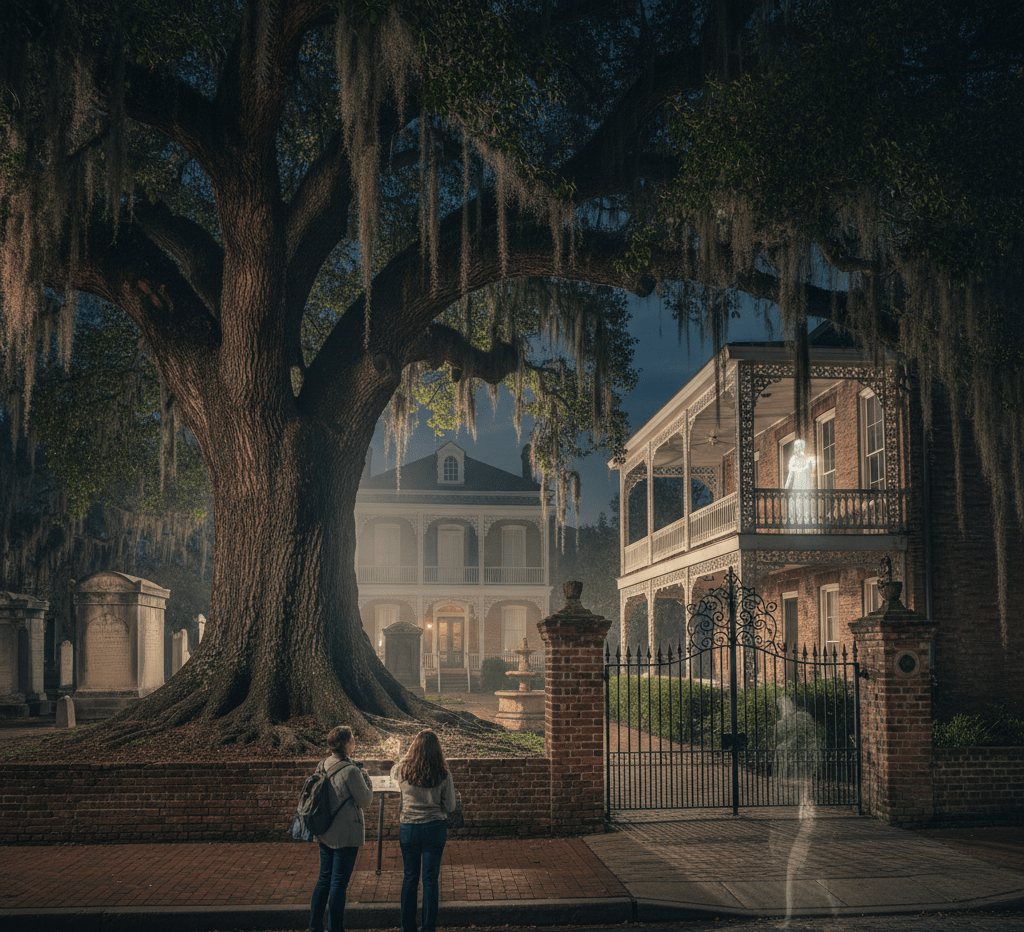
Mobile, Alabama, is a city born of water, war, and yellow fever. Founded in 1702 by French brothers Iberville and Bienville, it served as the first capital of French Louisiana before New Orleans was even a glimmer in a cartographer’s eye. With over three centuries of turbulent history—including occupation by five different flags (French, British, Spanish, Republic of Alabama, and the United States)—it is no surprise that the “Azalea City” has a few skeletons in its antebellum closets.
While the Spanish moss draping the live oaks provides a natural Southern Gothic atmosphere, the real chills come from the city’s documented history. Mobile has survived devastating fires, naval blockades, and some of the deadliest yellow fever outbreaks in American history. These events have left a psychic scar on the landscape. Whether you are a skeptic looking for a history lesson or a believer hunting for EVPs (Electronic Voice Phenomena), ghost tours in Mobile offer a fascinating, bone-chilling glimpse into the past.
Here are the 10 most haunted places in Mobile, Alabama, where history refuses to stay buried.
1. The Boyington Oak: A Botanical Witness
Location: 250 Government St (Near the Church Street Graveyard)
If you only visit one haunted site in Mobile, make it this one. It is rare that a ghost story comes with tangible botanical proof, but the Boyington Oak is a unique exception to the rule of hearsay.
The Historical Context
In 1834, Charles Boyington was a young printer and gambler who had recently arrived from Connecticut. Known for his charm and his short temper, he was a frequent face in the city’s taverns. On a humid night in May, his friend Nathaniel Frost was found murdered in the Church Street Graveyard. Because Boyington was seen with Frost shortly before the discovery and was found with a large sum of money, he was arrested. Despite a lack of eyewitnesses or a murder weapon, the circumstantial evidence was enough for a 19th-century jury.
The Legend vs. The Reality
Moments before his hanging on February 20, 1835, Boyington declared his innocence one final time. He prophesied that a mighty oak tree would spring from his heart to prove he was wrongly accused. He was buried in a potter’s field just outside the consecrated walls of the Church Street Graveyard.
Within years, a Southern Live Oak grew directly out of his grave site. Today, the tree stands as a massive, gnarled monument. Local paranormal researchers claim that on quiet nights, the sound of weeping can be heard near the trunk. While skeptical arborists suggest the tree grew naturally, the sheer coincidence of its location remains one of Mobile’s most enduring mysteries.
2. The USS Alabama: The Battleship That Never Sleeps

Location: 2703 Battleship Pkwy
The “Mighty A” is a South Dakota-class battleship that saw significant combat in World War II. Now a museum ship at Battleship Memorial Park, it is a 35,000-ton steel labyrinth that many claim is still crewed by those who never left their posts.
The History of the “Mighty A”
The USS Alabama earned nine Battle Stars during her service. While the ship was never sunk and was known as a “lucky” vessel, life aboard was grueling. Men lived in cramped, hot quarters under constant threat of kamikaze attacks. Several deaths occurred on board due to accidents, including a tragic friendly-fire incident in a 5-inch gun mount that claimed the lives of eight sailors.
Reported Paranormal Activity
Documented accounts from night watchmen and overnight “living history” participants often cite hearing heavy, rhythmic footsteps on metal grates in empty corridors. Two specific entities are frequently reported:
- The Mess Hall “Bully”: A spirit that allegedly makes its presence known by clattering trays and creating an atmosphere of intense unease in the galley area.
- The Officer: A shadowy figure in a crisp uniform has been spotted in the officers’ quarters, standing as if waiting to receive a report.
Related articles:
The 10 Most Haunted Places in Massachusetts
10 Most Haunted Places in the United States
3. Richards-DAR House: The Children of Joachim Street
Location: 256 N Joachim St
This stunning Italianate townhouse, renowned for its iron lace and ruby-glass transom, serves as a museum for the Daughters of the American Revolution (DAR). It is also widely considered one of the most active paranormal sites in the state.
The History of the Richards Family
Built in 1860 for Steamboat Captain Charles G. Richards and his wife Caroline, the home was designed to showcase the family’s wealth. The Richards family raised numerous children within these walls. Unlike many “haunted” houses, there is no record of a gruesome crime here; rather, it is believed that the family simply loved the home too much to leave it.
The Haunting
The activity at the Richards-DAR House is famously benign. Docents and visitors frequently report:
- The Giggling Children: The distinct sound of children laughing and running in the upstairs hallway when the house is empty.
- Phantom Scents: The smell of Captain Richards’ pipe tobacco or the scent of lavender perfume often drifts through the parlors during tours.
- Interactive Toys: In the nursery, period-accurate toys have been reported to move or spin on their own when guests are not looking.
4. The Malaga Inn: Room 007
Location: 359 Church St
Comprised of two twin townhouses built in 1862 during the Civil War, the Malaga Inn is a boutique hotel that blends Confederate-era history with ghost-story fame.
The History
The twin homes were built by brothers-in-law Isaac Goldsmith and William Frohlichstein. During the Union occupation of Mobile, the houses remained standing, allegedly due to the diplomatic prowess of the owners. A tunnel system was rumored to exist beneath the homes, potentially used for smuggling goods during the naval blockade of the port.
The Haunting
Room 007 is the focal point of the hotel’s lore. Guests have reported:
- The Swinging Chandelier: A heavy light fixture in the room has been seen swaying violently even when the air conditioning is off.
- The Lady on the Balcony: A “Lady in White” is occasionally spotted pacing the wrought-iron balcony overlooking the courtyard. She is said to look longingly toward the Mobile River.
- Disappearing Personal Items: Guests often find their keys or jewelry moved to odd locations within the room, a phenomenon attributed to “playful spirits.”
5. Church Street Graveyard: The Yellow Fever Legacy
Location: Church St (adjacent to the Mobile Public Library)
Established in 1819, this is Mobile’s oldest burial ground. It is a place of profound silence, dominated by raised brick tombs necessitated by the city’s high water table.
The History of the Epidemic
During the 19th century, Mobile was plagued by yellow fever. In 1853 alone, nearly 8% of the city’s population was wiped out. The Church Street Graveyard filled so quickly that it eventually had to be closed to new burials. The sheer density of “hurried” burials—where bodies were interred quickly to prevent the spread of disease—has led to much of the graveyard’s paranormal reputation.
Reported Experiences
Locals often describe “cold spots” that move through the graveyard, even during 90-degree Alabama summers. The most common report is that of shadow figures darting between the tombs. Because the cemetery is adjacent to the public library, many staff members have reported seeing figures in 19th-century dress walking through the stacks, perhaps looking for their own lost histories.
6. The Battle House Renaissance Hotel
Location: 26 N Royal St
This luxury hotel is a cornerstone of downtown Mobile. It stands on the site where Andrew Jackson headquartered during the War of 1812, adding layers of military history to its ghostly resume.
The History of the Fire
The original Battle House (opened in 1852) was a massive wooden structure that hosted presidents and royalty. In 1905, it was destroyed by a catastrophic fire. The current hotel, built in 1908, was designed to be fireproof, yet it seems to have retained the spirits of its predecessor.
The Spirits of the Ballroom
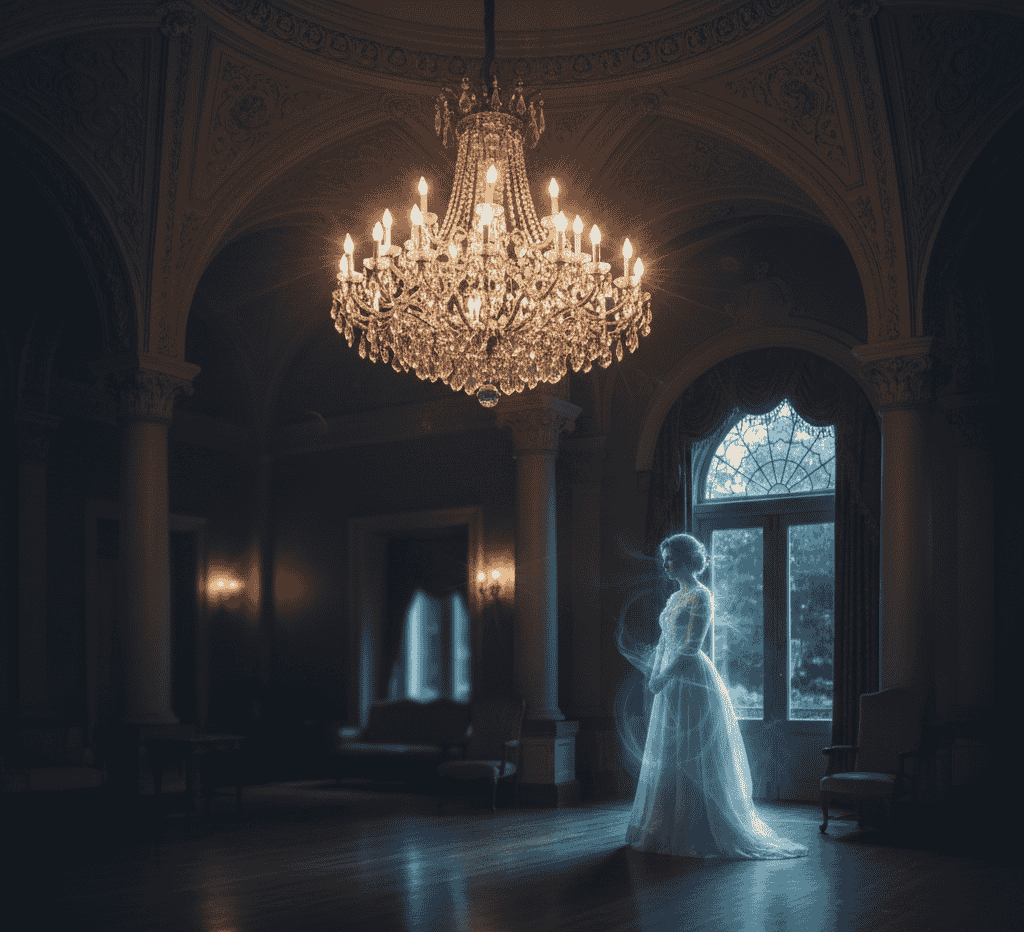
The most famous resident ghost is a bride from the early 1900s. Legend says she took her own life after being left at the altar. Her apparition is frequently seen in the Crystal Ballroom, particularly by staff working late-night shifts. Others have reported a gentleman in a top hat who stands in the lobby, appearing perfectly solid until he vanishes near the elevators.
7. Bragg-Mitchell Mansion: The Lady of the Oaks
Location: 1906 SpringHill Ave
This 13,000-square-foot mansion is the pinnacle of Greek Revival architecture in Alabama. Its massive columns and sweeping lawn make it a popular wedding venue, but the “Lady of the Mansion” remains its most permanent resident.
The History
Built in 1855 by Judge John Bragg, the home was intended for the social season. During the Civil War, the family was forced to cut down their beloved oak trees to provide a clear line of fire for the Confederate cannons defending the city. This loss was said to have broken the heart of the family.
The Haunting
The spirit of a woman is often seen looking out from the second-floor windows. She is known as a “protective” spirit; docents have reported that she will close doors left ajar or straighten photos on the walls. There is also a famous account of a “phantom cat” that rubs against the ankles of visitors, though no living cat resides on the property.
8. Barton Academy: Echoes of the Infirmary
Location: 504 Government St
As the first public school in Alabama (founded 1836), Barton Academy is an architectural masterpiece. Its history, however, took a dark turn during the Civil War.
The History
Following the Battle of Mobile Bay, Union forces occupied the city and converted Barton Academy into a makeshift military hospital. The hallways that once echoed with the sounds of students were filled with the groans of the wounded and dying.
Reported Phenomena
Construction workers and evening staff have reported the sound of phantom footsteps and the heavy scent of antiseptic or “hospital smells” in the basement levels. Most chilling are the reports of “shadow soldiers” seen standing guard near the front entrance, seemingly unaware that the war ended over 150 years ago.
9. Fort Morgan: The Guardian of the Bay
Location: 110 State Highway 180, Gulf Shores (approx. 45 miles from Mobile)
While technically a short drive south, Fort Morgan is the gateway to Mobile and the site of its most violent history.
The History
Fort Morgan was the site of the pivotal Battle of Mobile Bay in 1864. The fort was bombarded for weeks, leading to hundreds of casualties. The masonry “star fort” is a place of dark corners and immense history.
The Haunting
Visitors have reported hearing the sounds of cannons and musket fire when the fort is empty. The “Mistress of the Fort” is a female entity said to search the barracks for her lost husband. Because the fort is so large and mostly outdoor, the wind creates eerie whistling sounds that many locals believe are the voices of the fallen.
10. The Seamen’s Bethel (University of South Alabama)
Location: USA Campus, St. Anthony St
This building has literally moved through time and space, having been relocated from the waterfront to the university campus to prevent its demolition.
The History
Constructed in the 1860s, it served as a chapel and social center for sailors who were often far from home and frequently ill. It was a place of both sanctuary and sorrow.
The Haunting
The most famous spirit is the “Old Rebel,” a man believed to be a former caretaker. Since the building was moved, he has reportedly been more active, perhaps confused by the change in scenery. He is known for flickering the lights during student presentations and locking doors behind tour groups.
Understanding Mobile’s “Haunted Geography”
Mobile’s hauntings are unique because they are tied to its geographic modifiers. The city is built on marshy soil with a high water table, which local folklore suggests “traps” energy. Furthermore, the city’s historic districts—De Tonti Square, Oakleigh, and the Church Street District—are some of the most concentrated areas of 19th-century architecture in the South
Conclusion: The Living History of the Azalea City
Mobile, Alabama, is a city that respects its dead. The stories of Charles Boyington or the sailors of the USS Alabama are not just legends; they are part of the cultural fabric of the Port City. Whether you are walking through the gas-lit streets of the historic district or exploring the cold steel decks of a battleship, you are engaging with a past that refuses to fade away.
If you find yourself in Mobile, keep your eyes on the upstairs windows of the old mansions and your ears open for the rustle of a silk dress. In a city this old, you are never truly walking alone.
- Walking Tours: Most tours depart from the Bienville Square area. Wear comfortable shoes!
- Paranormal Equipment: Some “ghost hunts” provide EMF meters or dowsing rods.
- History First: The best tours focus on the “True History” of the locations, allowing the spooky elements to arise naturally from the facts.
