
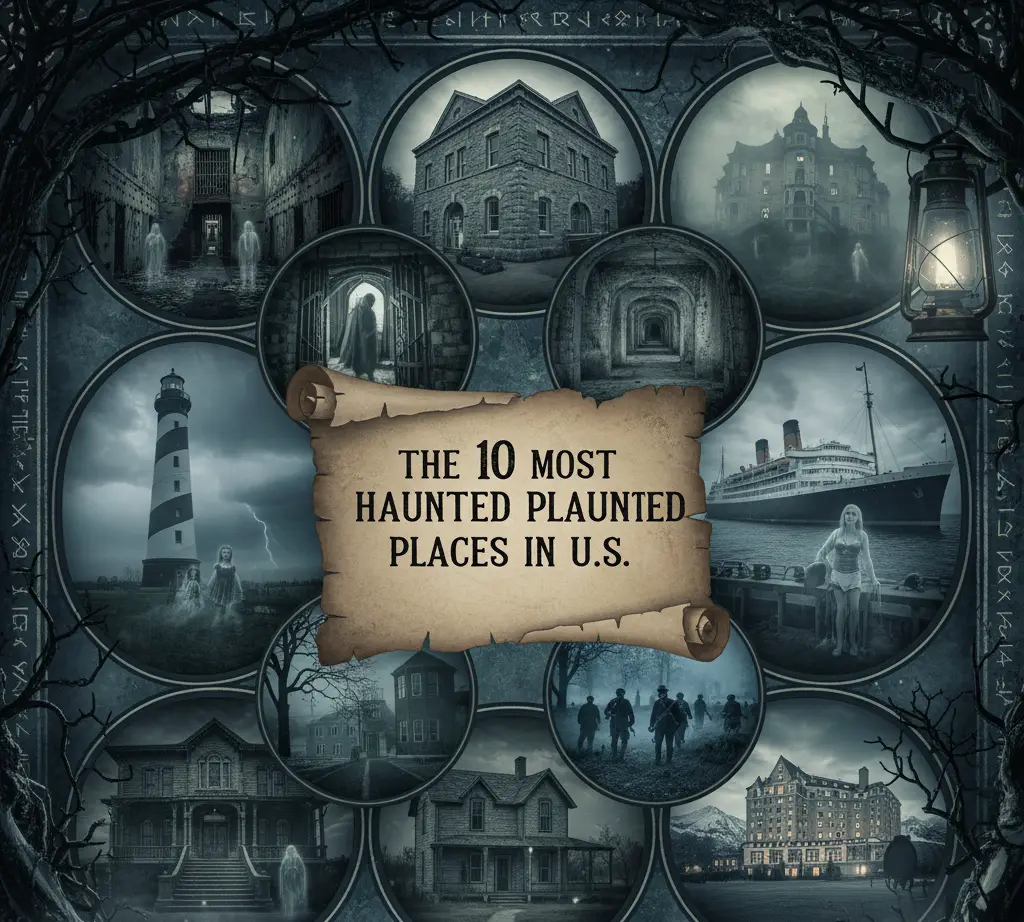
1. Eastern State Penitentiary - Philadelphia, Pennsylvania
This former prison operated for 142 years before closing in 1971 and is now a museum added to the National Register of Historic Places in 1966.
The prison originated from a Quaker movement led by Benjamin Franklin and Benjamin Rush that focused on reform through solitary confinement, a practice that continues in modern prisons today.
Notorious prisoner Al Capone reported nightly hauntings by a victim of his St. Valentine’s Day massacre during his imprisonment.
Modern investigators and visitors report sightings of shadow figures walking through cell blocks, hearing whispering, giggling, and crying without finding a source, and being touched by cold hands only to turn around and find no one there. The prison offers tours year-round and features elaborate Halloween attractions.
2. Waverly Hills Sanatorium - Louisville, Kentucky
This five-story tuberculosis hospital opened in October 1926 with capacity for more than 400 patients. Once the cure for tuberculosis was found in 1943, the number of cases gradually lowered and the hospital closed in June 1961.
While some claim as many as 68,000 people died at the property, the real number is believed to be closer to 8,000.
The sanatorium featured a tunnel equipped with a cable car that, according to stories, served to transport corpses to waiting ambulances at the bottom of the hill during the 1920s-1940s, sparing patients the knowledge that someone had died.
Visitors encounter the ghost of a doctor in a white lab coat entering the fourth-floor operating room, a ghost chef in the abandoned kitchen with smells of baking bread, and on the fifth floor, the full-bodied apparition of a woman running down the corridor with her wrists cut, screaming. The facility now offers historical tours, paranormal tours, and private overnight investigations.
3. The Stanley Hotel - Estes Park, Colorado
Built by Freelan Oscar Stanley who came to Colorado in 1903 suffering from tuberculosis, the 140-room Georgian Revival hotel opened on July 4, 1909.
In 1974, Stephen King stayed in Room 217 and had a nightmare where he watched his young son being chased through the hall by an enormous, living firehose, which inspired his novel The Shining.
In 1911, during a large storm, head housekeeper Mrs. Elizabeth Wilson was lighting lanterns in Room 217 when an explosion occurred, blasting her through the floor into the MacGregor Dining Room below, though she survived with only broken ankles.
Now she spends her afterlife still taking care of the room, with guests reporting items moved, luggage unpacked, and lights being turned on and off, and she isn’t a fan of unmarried guests sleeping in the same bed, with some couples reporting feeling a cold force come between them.
F.O. Stanley himself is often seen in the lobby and Billiard Room, while his wife Flora haunts the ballroom, entertaining guests with piano playing, with employees and guests hearing music coming from the room and seeing the piano keys moving.
4. RMS Queen Mary - Long Beach, California
Built in 1926, the ship served as lavish vacation transportation for the rich and immigrants until the Great Depression delayed her first voyage until 1936.
During the war, luxury furnishings were stripped away to transport hundreds of soldiers—she carried more than 800,000 soldiers on 72 trips, and after the war became stationary and was converted into a hotel.
In her years at sea, the Queen Mary had 49 deaths aboard, including a crew member crushed by Hatch Door #13 whose ghost is said to be roaming the area, with guests and workers hearing him whistling or asking for a wrench.
In state rooms, people have had covers pulled off them at night and see realistic figures that then fade away, beds are made and unmade, lights that were off turn on, and water starts running on its own, while guests also feel cold spots or people brushing against them even when they’re alone.
5. LaLaurie Mansion - New Orleans, Louisiana
Located in the French Quarter, this multistory neoclassical home originally belonged to Madame Delphine LaLaurie, a wealthy socialite known for her lavish parties and later for her cruelty.
In 1834, a slave set fire to the home, and those who came to quench the blaze uncovered the horrific living conditions of some of its residents, many of whom are said to still haunt the mansion nearly 200 years later.
The mansion is considered one of the most chilling haunted places in New Orleans, with reports of cigar smoke and ghostly moans still haunting the rooms. The dark history involves torture and abuse, making it one of the most disturbing haunted locations in America.
6. Myrtles Plantation - St. Francisville, Louisiana
Built in 1796 by exiled General David Bradford, the 600-acre estate is well known for a roster of hauntings, with stories ranging from the macabre to the fantastical.
Phantoms of generations past are said to walk the plantation’s halls, keeping guests company and adding a certain mystique to the atmosphere of this home that seems frozen in time and unable to let go of its past.
The plantation offers tours and overnight stays, with guests reporting encounters with various spirits throughout the property. It’s considered one of the most actively haunted plantations in the South.
7. Winchester Mystery House - San Jose, California
In 1881, widowed Sarah Winchester became heir to the Winchester Rifle fortune after her husband William Wirt Winchester died of tuberculosis, having lost her young daughter a few years earlier.
A grief-stricken Sarah consulted a medium who instructed her to move out west and create a home for herself and the souls of those killed by Winchester rifles—lest they haunt her forever.
The house is filled with staircases to nowhere and doors that open into walls, with some believing she built the home to appease ghosts of those killed by Winchester rifles.
The bizarre architecture includes doors that open to brick walls, stairs leading to ceilings, and windows overlooking other rooms, creating a disorienting labyrinth.
8. St. Augustine Lighthouse - St. Augustine, Florida
Known for its scenic views and haunted history, this lighthouse is said to be visited by the ghosts of children who died in an accident during its construction.
Many visitors have reported laughter, shadowy figures, and mysterious footsteps echoing in the tower.
The lighthouse offers both historical and paranormal tours, with the spirits of the children being the most commonly reported phenomena. Visitors also report hearing voices and seeing apparitions throughout the structure.
9. The Amityville Horror House - Amityville, New York
On November 13, 1974, Ronald DeFeo Jr. killed six members of his own family as they slept, later claiming he did it because of “voices from the house”.
One year later, George and Kathy Lutz bought the 4,000 square foot, five-bedroom Dutch Colonial house and, knowing its history, hoped to start fresh but instead were driven out after just 28 days by alleged extreme paranormal activity that turned the house into a world-famous haunting.
The case became one of the most famous hauntings in American history, spawning numerous books and films, though the authenticity of the Lutz family’s claims remains debated.
10. Gettysburg Battlefield - Gettysburg, Pennsylvania
The site of one of the bloodiest battles of the Civil War, Gettysburg has developed a haunted reputation over the years. The three-day battle in July 1863 resulted in over 50,000 casualties, with soldiers from both sides dying on the fields.
Visitors report seeing apparitions of soldiers, hearing cannon fire and battle cries, smelling gunpowder, and experiencing unexplained cold spots throughout the battlefield. The area around Devil’s Den and Little Round Top are particularly known for paranormal activity, with photographs often capturing mysterious figures in period uniforms.
These locations represent some of the most documented and visited haunted sites in America, each with its own tragic history and countless reports of paranormal activity from visitors, investigators, and staff over many decades.
